Original: $913.34
-70%$913.34
$274.00The Story
Trident Audio HI-LO Overview
- 1Description
- 2The Hi-Cut
- 3The Lo-Cut
- 4Dynamic Tracking
- 5Further Filtering Possibilities
- 6Dynamic Linked Stereo Tracking
- 7API Radial Workorse
- 8Wired in Series
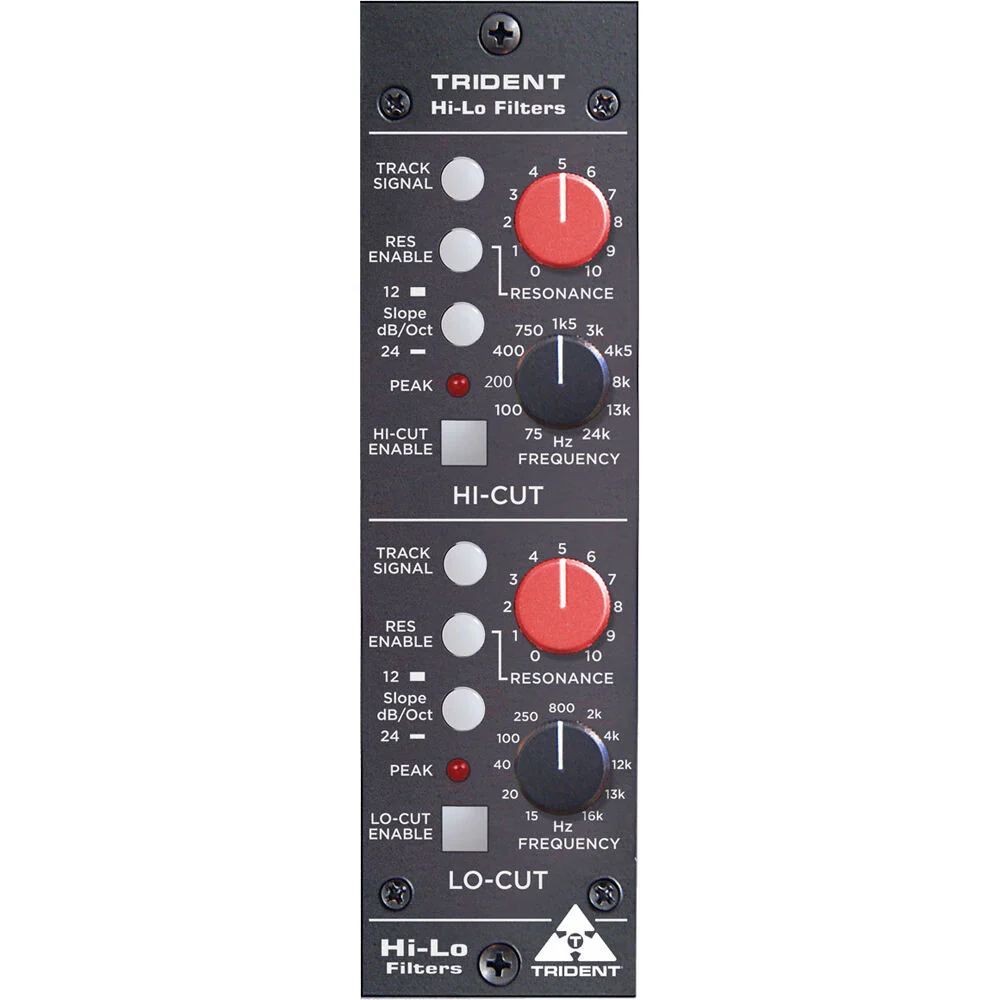
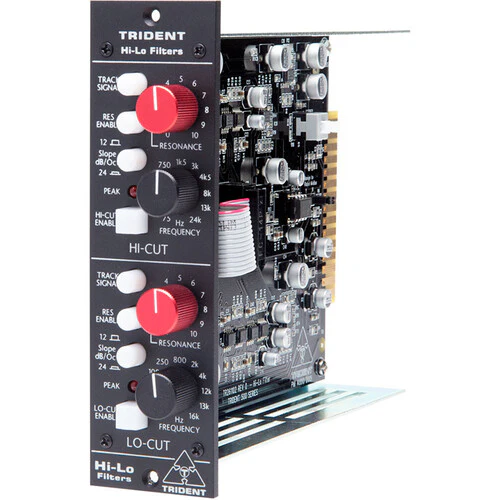
Make it easier than ever to clean up your recorded audio with the Hi-Lo Tracking Filters from Trident Audio, an analog 500-series rack module that sports two dynamic, program-adaptive tracking filters, one high-pass and one low-pass, for quickly cutting out unwanted rumbles, hums, and general noise like tape hiss. Both filters are sweepable and sport resonance peak control, selectable slopes between 12 and 24 dB per octave, and red LEDs for peak indication.
The Hi-Lo Tracking Filters feature an extremely wide frequency response and sweeping range, capable of tackling virtually any audio material and allowing for unique effects to be achieved when combined with high resonance settings. The module supports stereo linking with a second Hi-Lo for stereo filter processing, series wiring for a nearly unlimited range of filter slopes, and built-in support for the mixing facilities of the API Radial Workhorse chassis.
In addition, a Resonance control can be switched into circuit, to introduce a resonant peak at the selected cutoff frequency. The size of this peak, which is dependent on the elected frequency selected on the front panel, can be varied from zero to approximately +12 dB. A Hi-Cut Enable switch allows each individual frequency band or filter to be assessed, while a red Peak warning indicator will illuminate at around +16 dBu, approximately 12 dBu below clipping.
In addition, a Resonance control can be switched into the circuit, to introduce a resonant peak at the selected cutoff frequency. The size of this peak, which is dependent on the elected frequency selected on the front panel, can be varied from zero to approximately +12 dB. A Low-Cut Enable switch allows each individual frequency band or filter to be assessed, while a red Peak warning indicator will illuminate at around +16 dBu, approximately 12 dBu below clipping.
By enabling both Hi-Lo modules Track Signal switches, and setting the frequency controls to identical positions, the left and right signals are now summed together, and the automatic tracking follows both the left and right signal sources. When using a 500-Series rack with selectable stereo pairing on the rear of the rack, such as with the Trident Deca-Dent, you can release the onboard stereo link switches and both modules can be used as separate mono units without the need to access the rear of the rack.
By adjusting one of the Hi-Cut filters to 12 dB, the program material will be subject to a 36 dB slope. The introduction of a third Hi-Lo in series with the first two Hi-Lo modules would provide for yet steeper slopes, again in increments of 12 dB. In fact, because they can be connected in series, you�re only limited by the number of Hi-Lo�s that you have on hand.
In the Box
- Trident Audio Hi-Lo 500-Series Tracking Filters
- Limited 1-Year Manufacturer Warranty
- Description
- The Hi-Cut
- The Lo-Cut
- Dynamic Tracking
- Further Filtering Possibilities
- Dynamic Linked Stereo Tracking
- API Radial Workorse
- Wired in Series
Trident Audio HI-LO Specs
| Frequency Response |
15 Hz to 60 kHz (-3 dB)
|
| Input Impedance |
10 Kilohms
|
| Maximum Input Level |
+27 dBu
|
| Maximum Output Level |
+27 dBu (Into 600 Ohms)
|
| Distortion |
0.0031% (+10 dBu Output)
0.0069% (+20 dBu Output) |
| Noise |
-95 dBu (No Filters in Circuit)
|
All product and company names are trademarks™ or registered® trademarks of their respective holders. Use of them does not imply any affiliation with or endorsement by them.
Details & Craftsmanship
Every detail has been carefully considered to bring you the perfect product.
Description
Trident Audio HI-LO Overview
- 1Description
- 2The Hi-Cut
- 3The Lo-Cut
- 4Dynamic Tracking
- 5Further Filtering Possibilities
- 6Dynamic Linked Stereo Tracking
- 7API Radial Workorse
- 8Wired in Series
Make it easier than ever to clean up your recorded audio with the Hi-Lo Tracking Filters from Trident Audio, an analog 500-series rack module that sports two dynamic, program-adaptive tracking filters, one high-pass and one low-pass, for quickly cutting out unwanted rumbles, hums, and general noise like tape hiss. Both filters are sweepable and sport resonance peak control, selectable slopes between 12 and 24 dB per octave, and red LEDs for peak indication.
The Hi-Lo Tracking Filters feature an extremely wide frequency response and sweeping range, capable of tackling virtually any audio material and allowing for unique effects to be achieved when combined with high resonance settings. The module supports stereo linking with a second Hi-Lo for stereo filter processing, series wiring for a nearly unlimited range of filter slopes, and built-in support for the mixing facilities of the API Radial Workhorse chassis.
In addition, a Resonance control can be switched into circuit, to introduce a resonant peak at the selected cutoff frequency. The size of this peak, which is dependent on the elected frequency selected on the front panel, can be varied from zero to approximately +12 dB. A Hi-Cut Enable switch allows each individual frequency band or filter to be assessed, while a red Peak warning indicator will illuminate at around +16 dBu, approximately 12 dBu below clipping.
In addition, a Resonance control can be switched into the circuit, to introduce a resonant peak at the selected cutoff frequency. The size of this peak, which is dependent on the elected frequency selected on the front panel, can be varied from zero to approximately +12 dB. A Low-Cut Enable switch allows each individual frequency band or filter to be assessed, while a red Peak warning indicator will illuminate at around +16 dBu, approximately 12 dBu below clipping.
By enabling both Hi-Lo modules Track Signal switches, and setting the frequency controls to identical positions, the left and right signals are now summed together, and the automatic tracking follows both the left and right signal sources. When using a 500-Series rack with selectable stereo pairing on the rear of the rack, such as with the Trident Deca-Dent, you can release the onboard stereo link switches and both modules can be used as separate mono units without the need to access the rear of the rack.
By adjusting one of the Hi-Cut filters to 12 dB, the program material will be subject to a 36 dB slope. The introduction of a third Hi-Lo in series with the first two Hi-Lo modules would provide for yet steeper slopes, again in increments of 12 dB. In fact, because they can be connected in series, you�re only limited by the number of Hi-Lo�s that you have on hand.
In the Box
- Trident Audio Hi-Lo 500-Series Tracking Filters
- Limited 1-Year Manufacturer Warranty
- Description
- The Hi-Cut
- The Lo-Cut
- Dynamic Tracking
- Further Filtering Possibilities
- Dynamic Linked Stereo Tracking
- API Radial Workorse
- Wired in Series
Trident Audio HI-LO Specs
| Frequency Response |
15 Hz to 60 kHz (-3 dB)
|
| Input Impedance |
10 Kilohms
|
| Maximum Input Level |
+27 dBu
|
| Maximum Output Level |
+27 dBu (Into 600 Ohms)
|
| Distortion |
0.0031% (+10 dBu Output)
0.0069% (+20 dBu Output) |
| Noise |
-95 dBu (No Filters in Circuit)
|
All product and company names are trademarks™ or registered® trademarks of their respective holders. Use of them does not imply any affiliation with or endorsement by them.